Straight Arrow
A Hero With Two Identities
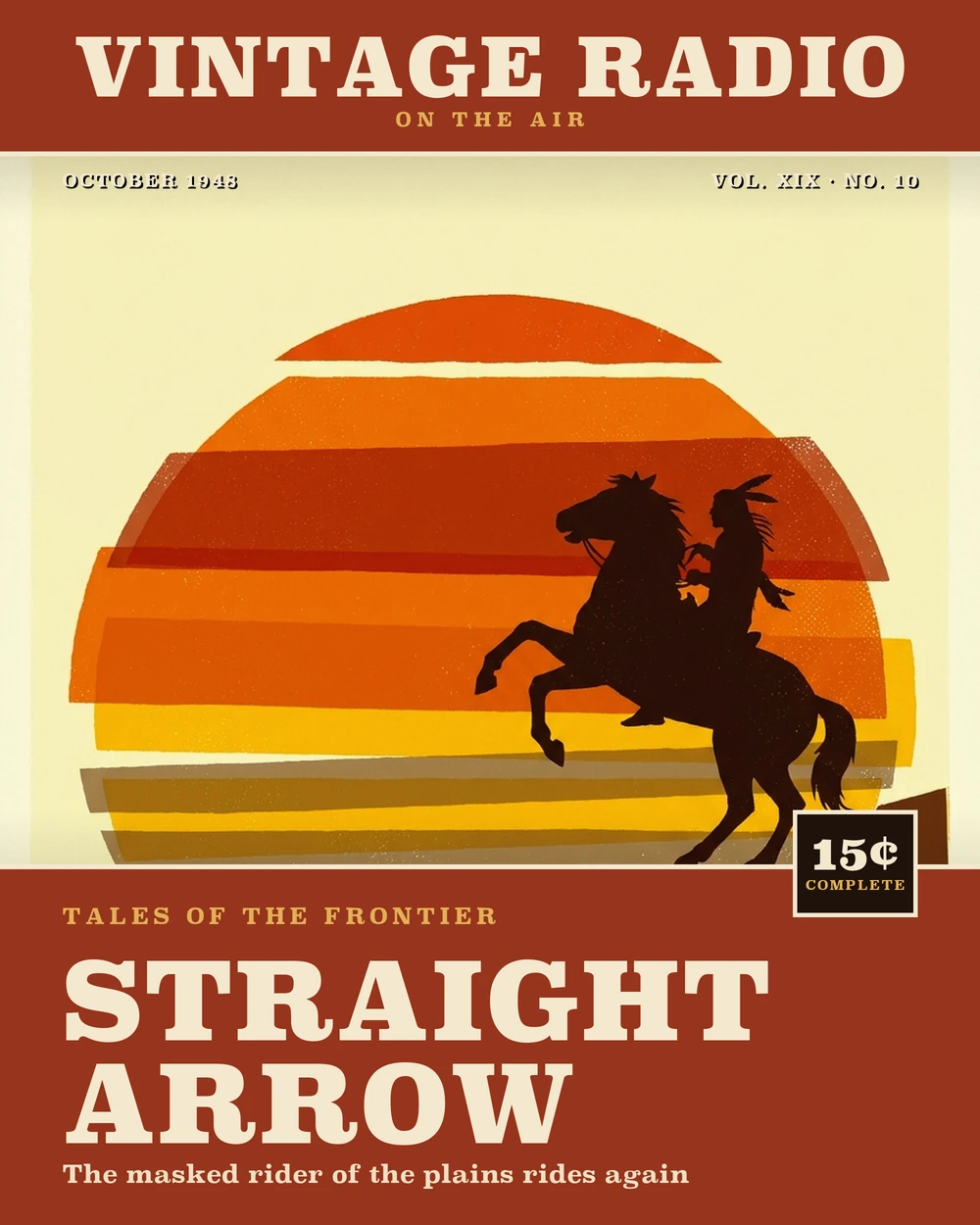
Most radio westerns of the late 1940s kept things simple: a good guy with a gun, a sidekick, and a town to protect. Straight Arrow inverted that formula in a way that nobody else had tried. Steve Adams looked to his neighbors like nothing more than the young owner of the Broken Bow cattle spread, somewhere in the Colorado Rockies of the 1870s. But Steve Adams was of Comanche descent, taken in and raised by a ranching family as a white man — and in times of trouble, he shed that assumed identity entirely, rode out of a secret cave on a golden palomino named Fury, and became Straight Arrow, fulfilling an Indian legend about a great warrior destined to save his people. Researcher William Harper has described this as the inverse of the usual masked-hero formula: rather than a white man putting on an Indian costume, Steve Adams removes his white identity to reveal who he actually is.
The show premiered on May 6, 1948, on the West Coast Don Lee Network, where it aired on Tuesdays. The McCann-Erickson Advertising Agency in New York had been given a specific assignment: build a radio vehicle that would sell Nabisco Shredded Wheat to children and help Nabisco compete against Post, Kellogg's, and General Mills in the kids' cereal market. McCann-Erickson decided to produce the show out of Los Angeles and cast from West Coast talent. The initial script, written by Sheldon Stark, was finished in January 1948. After a regional trial run through January 21, 1949, the show moved to the Mutual Network on February 7, 1949, alternating weekly with Bobby Benson and the B-Bar-B Riders, and began airing coast to coast. It continued until its last broadcast on June 21, 1951 — 292 episodes in all.
The Sound of the Show
The opening was carefully built and stayed largely unchanged from the first episode to the last. Frank Bingman's narration established the Steve Adams cover story, then the transformation: the cave, the golden palomino Fury, the ride out into darkness to take up the cause of law and order throughout the West. Indian drumbeats ran underneath. A chanted, Indian-style jingle spelled out N-A-B-I-S-C-O — Nabisco's brand woven directly into the show's ritual opening rather than parked in a break.
The most distinctive sound effect was the arrow in flight, and it came from an unexpected source: Milton Charles played a Hammond B-2 organ, and by using a tremolo, he produced a whistling, hissing tone that suggested an arrow cutting through air, followed by the sound of impact. Radio Life predicted that the effect "will make shivers tingle down your spine." Straight Arrow's call to his horse — "Kaneewah, Fury!" — was delivered through an echo chamber, giving it a size and resonance that a plain vocal couldn't achieve. The dialogue also incorporated what were presented as authentic Indian phrases; "Manitu-wah," meaning farewell, appeared throughout the run.
In 1949, producer-director Ted Robertson and soundman Ray Kemper traveled to Gallup, New Mexico, to record at an intertribal Indian ceremonial gathering. That on-site research informed both sound effects and the texture of the show's dialogue and setting.
The Cast and the People Behind It
Howard Culver played both Steve Adams and Straight Arrow, and the dual role required him to do something technically demanding: modify his voice to distinguish the two characters. The shift was compared at the time to Bud Collyer's vocal movement between Clark Kent and Superman. Culver was born on June 4, 1918, in Larimer County, Colorado, grew up in Los Angeles, and started in radio as a senior at Manual Arts High School. He served three years in the U.S. Navy during World War II, then returned to radio in Hollywood and San Francisco. Just before landing the Straight Arrow role in early 1948, he had been the last actor to portray Ellery Queen on The Adventures of Ellery Queen. He had also narrated We Deliver the Goods and announced on Chandu the Magician.
Being under contract as the star of Straight Arrow had an ironic consequence for Culver. In the summer of 1949, he recorded an audition for a new western then being developed under the working title "Mark Dillon Goes to Gouge Eye," playing the Dodge City lawman who would eventually be renamed Matt Dillon. Because he was contractually forbidden from appearing on competing westerns, he couldn't take the role when the show went to series in 1952. It went to William Conrad instead, and the show became Gunsmoke. After Straight Arrow ended, Culver co-starred opposite Mercedes McCambridge on ABC's Defense Attorney (1951–52), and later appeared throughout the entire 20-year television run of Gunsmoke as Howie Uzzell, the hotel desk clerk at the Dodge House, through the series' penultimate season in 1974. He was also a frequent presence on Jack Webb productions: both versions of Dragnet, Adam-12, and Project U.F.O. Culver died on August 4, 1984, at age 66, after contracting meningitis while vacationing in Hong Kong.
Fred Howard played Packy McCloud, Steve Adams's grizzled ranch hand sidekick and the only person besides the audience who knew Steve's true identity. Gwen Delano played Mesquite Molly. Frank Bingman, the announcer-narrator, had started in radio at 19 on The Life of Mary Southern and was widely recognized before Straight Arrow as the voice of Cresta Blanca Wine commercials. Bingman and Culver became close friends during the production and together volunteered time at military hospitals teaching wounded veterans to knit.
Sheldon Stark wrote the show across its entire run. Before Straight Arrow, he had spent roughly ten years at WXYZ in Detroit writing for The Green Hornet and Challenge of the Yukon, producing more than 500 scripts including work on The Lone Ranger. He also helped form the Radio Writers Guild, which later merged into the Writers Guild of America. After radio, Stark became a television writer with credits on The Fugitive, Mission: Impossible, Batman, The Waltons, and the television version of The Green Hornet; he received a Writers Guild of America Award nomination in 1974 for a Waltons episode. He died in Los Angeles on February 6, 1997, at age 87.
The show was produced briefly by Neil Reagan — John Neil Reagan, older brother of the future U.S. President, and a senior vice president at McCann-Erickson who oversaw the production for the agency. Reagan was reassigned when the show moved to Mutual's coast-to-coast schedule in February 1949, and Ted Robertson took over as producer-director for the remainder of the run. Sound effects were handled by Ray Kemper, Tom Hanley, Bill James, and Dick Moblo.
The Premiums and the Comics
Nabisco made the most of its sponsorship beyond the broadcasts themselves. Early in the run, the company held a contest to name Straight Arrow's palomino, which drew 50,000 box tops and name suggestions; the winning entry was Fury. The contest established the pattern for a sustained premium campaign that became as well-known as the show itself.
The centerpiece was the Injun-Uity Cards — a portmanteau of "injun" and "ingenuity" — distributed inside Shredded Wheat packages across four series of 36 cards each. Books 1 and 2 were printed in blue ink; Books 3 and 4 in green. Each card, measuring approximately 4 inches wide by 7¼ inches tall, was designed and illustrated by Fred L. Meagher and featured outdoor and craft skills presented in the spirit of Indian tradition. Both U.S. and Canadian editions were produced, with many Canadian cards printed in French. Nabisco also offered a compiled booklet collecting the first two complete series of 36 cards each, available by mail for box tops, and additional premiums including a headband with red feathers, a war drum, a golden tie clip, and a bandanna.
A Straight Arrow comic book, published by Magazine Enterprises, launched in February 1950 and ran 55 issues through March 1956 at ten cents per copy. Gardner Fox wrote most of the stories; Meagher provided interior art on all 55 issues, with inking by his wife Ruthanne. Frank Frazetta contributed at least two covers to the series, including a bear-attack scene on issue #3 in June 1950. A companion daily newspaper strip, with scripts by Fox and art by Joe Certa and John Belfi, ran from mid-1950 through August 1951. The property also reached international markets: Brazilian publisher RGE reprinted the Magazine Enterprises comics and, when the licensed material ran out, commissioned original stories under the translated title Flecha Ligeira, which reached 120 issues. New Zealand published its own editions in the early 1950s.
What Survived and What Came After
Only nine audio recordings of the 292 episodes are known to exist, as documented by William Harper's radio log. Harper and his wife Teresa, of North Augusta, South Carolina, maintained a fan newsletter into the 1990s, and Harper later published Straight Arrow: The Definitive Resource for the Straight Arrow Promotion 1949–1956 through BearManor Media, containing a complete episode log and full coverage of the premium campaign. Harper's research also appeared in the 2013 reference work Radio Rides the Range, edited by Jack French and David S. Siegel.
The show never made the jump to television, unlike a number of its contemporaries in kids' radio. What it did leave behind was a phrase. The expression "straight arrow," used to describe a person of integrity and moral uprightness, passed into common American speech through the show's three-year run — according to Harper's research, millions still use it without any awareness of its radio origins. In 2019, the rights to the Straight Arrow character and trademarks were transferred to Education Is Our Buffalo Community Centre, a Canadian-based Indigenous organization.